The Annual Shareholders’ Meeting
Cache Highline Water Association
April 7, 2025
The Annual Shareholders’ Meeting of the Cache Highline Water Association was held on April 7, 2025, at the North Logan City Library, 475 East 2500 North, North Logan, Utah, at 7 p.m. Approximately 114 people were present including company officers and employees. Jason Morgado (Water Manager) was excused from the meeting.
President Jon Wells welcomed the attendees and led the audience in the Pledge of Allegiance.
Board Member Christie Hansen was asked to read the April 1, 2024, minutes from the previous year’s annual meeting. Mike Morrill made a motion to accept the minutes as read. The motion was seconded by Mitch Schiffman and carried unanimously.
Elections
Three Board members’ terms are expiring: Keith Meikle, Jon Meikle, and JoAnn Nyman. Secretary Lyle Thornley conducted the election for the open positions. Casey Jones was nominated by Greg Nielsen and seconded by KJ Hoggan. Keith Meikle was nominated by Christie Hansen and seconded by Ron Boman. JoAnn Nyman was nominated by Scott Wallentine and seconded by Mitch Schiffman. Jon Meikle was nominated by Jon Wells and seconded by Mitch Schiffman. Ron Bowman made a motion that nominations cease, which was seconded by Mike Morrill and carried unanimously. Each nominee had the opportunity to discuss his/her qualifications for being on the Board of Directors.
Voting by ballot resulted in the reelection of Keith Meikle, JoAnn Nyman, and Jon Meikle to the 2025 Board of Directors. As ballot counting went past the end of the meeting, voting results were reported on the Company website.
Financial Report
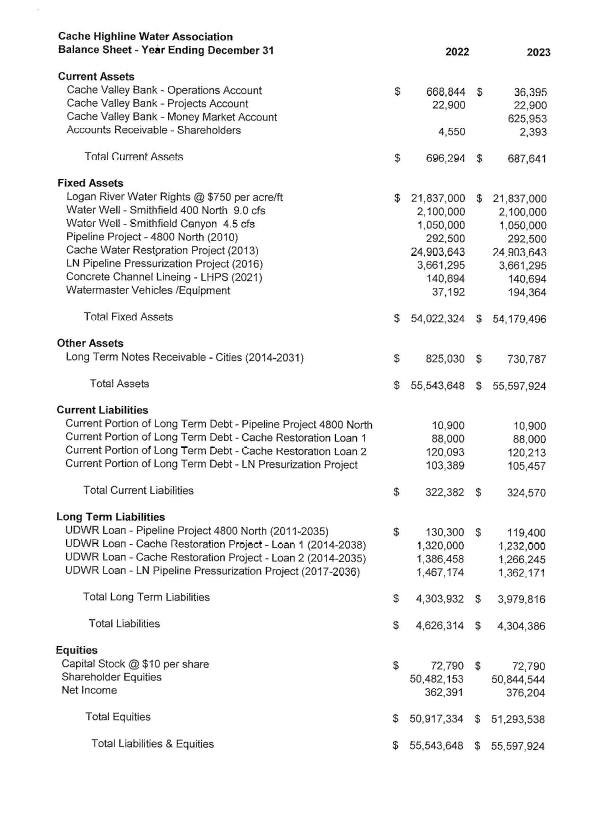
As Secretary of Cache Highline, Lyle Thornley explained the financial reports available on the Company website and in hard copy including the following information (see attachment).
Revenues. Assessments were similar to the prior year, increasing slightly as properties are divided, resulting in additional shareholders. Because we no longer carry canal water in the middle canal, the cities have contracted with CH to use that canal solely for storm water management. Interest income dropped because of the purchase of the North Logan building in September.
Expenses. Maintenance remained basically the same as the prior year. The diversion structure in Logan Canyon where the water is taken from Logan River did not require as many repairs last year as the year before. Electrical power expenses were up slightly; vehicle mileage, fuel, and legal fees remained about the same; salaries increased (an additional person was hired to work the north end of the canal and the Secretary, Lyle Thornley, received a raise), and taxes increased from $146,000 to $180,000. Depreciation expense came from the excavator purchased last year; depreciation on the building will begin this year (2025). Liability insurance actually decreased. Significant changes in the website increased that expense. Logan River Water Users’ annual assessment is CH’s share of the full-time commissioner’s salary; CH is by far the largest entity on that diversion. A significant change in consulting and engineering fees came from the Board of Directors’ contracting with Sunrise Engineering to provide a master plan study of the upper canal to determine where seepage is the worst. Interest payments were down because more of the debt is being paid down. Other more minor items were rearranged in the accounts to more accurately reflect the nature of the expenses. Depreciation and loan payments noted on the Income Statement were also explained.
Balance sheet. Assets, liabilities, and debts and loans were also explained including where water is allotted.
Phil Rasmussen made a motion to accept the financial documents as presented; Burt Israelsen seconded the motion which passed unanimously.
State of the Canal/Company
So far we have had a wet spring. Water will be turned into the Canal on the 26th of April. Allowing for debris and silt to work through the open system, users can then open headgates on May 1.
New building. President Jon Wells reported on the plans for remodeling the purchased building (2050 North 1200 East, North Logan). Initial plans were to build an equipment maintenance and storage shop next to the existing building, use the original foundation for company offices, and lease out the remaining space for income to offset the purchase price. However, it was determined that leasing could jeopardize the Company’s nonprofit status.
Planned repair projects. The following three projects will only go forward if funding becomes available.
-
CH has applied to the Bureau of Reclamation for a grant to pipe a portion of the upper canal from the SV road bridge to 600 South bridge in Smithfield City. Based on the leakage study, this is one of the worst areas of leakage. A pipe rather than lining an open channel was chosen as a safer choice as well as keeping debris out of the channel.
-
In Bury Hollow in Hyde Park, the canal makes a wide loop east and then back (around a large ravine). Potentially filling and straightening out the canal would lessen seepage and improve water flow as well as decreasing the liability of the canal bank failing in that area.
-
The Black Pipe is at the very end of our system and drops the canal water into Summit Creek. It is a huge liability; last year some debris got stuck in the pipe, and when it filled up, the pipe shifted several feet—the only thing holding it there is gravity. Smithfield Irrigation is a large shareholder in Cache Highline looking at doing some restoration there and would be a partner on this project.
Avoiding probate. This is something that was brought up in the State water meetings in St. George. There are a lot of shareholders who have their land in a trust. Associated water shares also need to be put in trust (HB 89); otherwise, the water shares will have to go through probate. This bill takes effect May 7 of this year.
Questions from Shareholders
The following concerns were expressed by Shareholders in the audience and addressed by the Board of Directors. Audience comments follow with Board of Director responses in italics and parentheses. In paragraphs without an identifying name at the beginning, no name was given or could not be heard; however, valid information was presented.
Burt Israelsen: What is the estimated cost of the first two projects? (The lining project is somewhere in the $3 million range; the Bury Hollow project is in the $500,000 range.)
Dean Adams: What is the estimated cost to complete reconstruction of the new building? (Approximately $100,000 including a conference room, a reception area, three offices, and the equipment shop.)
Steve Moore: Last year the plan was to lease three fourths of the building; do we really need the space, or could a portion of that building be sold? (It was decided that instead of spending additional money to put in a new footing foundation for our equipment shop, we would use the existing foundation, taking approximately half of the building for the equipment shop and the other half to be used as the office for the Company.)
Nolan Krebs: Somebody at the last shareholders’ meeting mentioned the fact that the Company could not lease out part of the building; why didn’t anyone pay attention to that? (The Company did not have official confirmation of the fact; however, the building is still a viable investment without leasing.)
It seems to me that part of the dilemma we have been expressing is because of our current corporate structure, 501.C3, and being surprised that we were not able to lease that space. My question is, as the building appreciates, does that compromise the value of our status? (Lyle Thornley: That would only take effect if the building were to be sold. Smithfield Irrigation, a much smaller company than we are, has had offices for 75 years with no change in status. I do not intend to spend eight hours a day sitting by the telephone. What I do want to do is if people want to meet with me, I can make an appointment with them at the Company offices so they don’t have to drive out to my house. I have three full file cabinets in my basement of records, beginning in 1986. I can’t throw away one stock certificate that is turned in; I can’t throw away an affidavit for a lost certificate that is turned in. I get calls all the time for successors asking if certificates are still valid.)
Gary Call: Once the building is completed, what is the yearly cost to maintain it with taxes, etc. (Gas, electricity, water, and sewer will be necessary just like any other building. Property taxes last year were $2,000 for approximately one third of the year ownership.)
(The other bid on the building [$200,000±] was nowhere near the commercial value of a one-third acre commercial lot in the heart of North Logan City—even without a building. In addition, this central location fits the needs of the Company. It is imperative that the Water Manager and his staff be able to get to the entire length of the canal in a timely manner when problems arise, especially with the open-channel portion. This was not a decision that was made lightly or quickly by the Board of Directors—it was discussed at length.)
Larry Seeley: Why didn’t the purchase of the building go to a shareholder vote? (A Shareholder vote is not required for $250,000 or less of indebtedness. The Company funds were adequate to support the purchase outright.)
Jerry ??: Last year the vote was to approve the purchase of the building based on revenue from leasing part of it. So does that invalidate the vote? (When the poll was taken last year, the bid for the building had already been made and accepted. The call for a vote was one of support rather than a “yea” or “nay” for the purchase of the building. No motion was made or seconded as a formal binding motion would be, and shareholder voting was not counted by the number of shares owned. The Board follows and acts within the Bylaws that have been accepted for the Company. All are welcome to attend Board meetings.)
(FYI – from the 2024 Annual Meeting) “Jon Wells made a request of those present: Those in favor of the Company’s purchasing the NL City Office building and using it for the CH permanent office, leasing out three quarters of it to other entities, indicate that approval by a raise of hands. Those opposed to the purchasing were then asked to raise their hands; only five hands were raised in opposition.”
(Keith Meikle: I would like to get to the heart of why the building was purchased. Our service goes from three miles up Logan Canyon to roughly a couple of miles north of Smithfield. We have equipment, trucks, mowers, all attachments for these, etc., all housed across a ten-mile area. We need a central location, we need office space and a place to house our equipment and saw this building as an opportunity for a central location where our managers could grab the equipment they need and go. As many of you know, Jason spent two weeks sleeping at the canyon diversion to keep it operating because of a mechanical issue, and for him to have to grab a piece of equipment seven miles away is just too difficult. We don’t have that many personnel that we can keep one person on call; it is basically Jason on call if you need help. We were looking for a central location; we wish we could have found just a shop; we couldn’t find anyone who was willing to donate a third of an acre to the Company to build on. We don’t operate like the cities where they can stick their sheds on the west side of that area, and we saw this building for sale; we saw there was a fair-market price for the building. Then as we looked into it, we saw how we could also turn it into a shop. Maybe we messed up; you have the right to vote us off the Board and put yourself on it. With the issues we deal with on a daily basis and what Jason deals with on an hourly basis, that was the best decision we thought we could make. Time will tell if we were wise or whether we were dupped. I’m not going to stand here and tell you that we had a crystal ball and know we did the right thing.)
(Jon Wells: One other issue we talked about as part of this, all of our records are being stored in personal homes, and we felt it is a look into the future because this system is only going to become more complicated as we go along, more complex, and therefore we felt that part of our decision is the future we could end up with, with more than one full-time employee, based on the complexity of our system. To meet the requirements that are coming from the State as well, it behooves us to have a permanent place for our records—that was also part of our discussion.)
Doug Younker: Maybe the discussion ought to go back to changing our bylaws about voting to get a loan or to purchase. I think that is part of the frustration—that is a big chunk of money to spend without asking the shareholders. (That’s a good point, and if you would like to attend a Board meeting and propose changes to the Bylaws, we can spend the next several months discussing them and preparing something to present to the shareholders, keeping in mind that we would have to wait until the next annual meeting to approve the changes.)
Gary Call: Are all the new meters on the pressurized system installed now and functioning? (The answer would need to come from Jason, who is not here; however, we believe he has the meters in place that he needs to. Our bylaws do require any new diversion/customer on that system to install a meter so that it can be monitored.)
(Requirements of the State of Utah came up a few years ago requiring all pressurized secondary water to be metered—CH was exempt because the water is taken from a stream rather than a reservoir, though that exemption may be revisited in the future. In addition, for every headgate meter, CH must, report usage to the State, and piping companies, using that meter as the strategic meter when applying for exemption, will also have to report usage.)
Greg Nielsen: We were told that we needed to put meters on all of our 76 users. (Section 3:i indicates an exemption because we don’t have storage. All of the rest of the bill relates to agriculture and open ditches, etc., which don’t apply to us, but you must apply for formal exemption from the State. If you have questions, contact Jason Morgado or Christie Hansen.)
Tyrell Bruff, Green Canyon Sprinkler Company: I would like to make motion to remove the annual end-user fee. (President Jon Wells: The Chair does not recognize the motion. Christie Hansen: All business before the Board must be on the agenda for voting. This is a public comment/question and answer period—not a formal motion period. It can also be made at a Board meeting if it is on the agenda.)
Sabine Barcatta: I would like to know who you consulted that told you that you could not rent out this building as a nonprofit. (This was discussed with our legal council, Emily Lewis, from Clyde Snow. Robert deBirk is currently the Company’s attorney).
Gary Call: Just looking at this from a business standpoint, the price of shares has been the same for how many years now? And yet the costs constantly rise in just doing business. At what point do you have to adjust the cost per share to compensate for the expenses that are being incurred? I would think that the cost of shares needs to rise with the other expenses we are taking on. (As the Board and shareholders ourselves, we have tried for the last several years to cover added expenses and inflation without undue billing increases, and we feel fortunate to have the Water Manager we do have in Jason Morgodo. I also want to applaud our Treasurer for his efforts to keep costs down. At some point there will have to be some adjustments to meet the added expenses.)
When is the last time this company was audited by an external company? (Since 1986 Logan Northern Irrigation Company has not been audited; Logan, Hyde Park & Smithfield Canal Company was not audited; and Cache Highline has not been audited. Lyle would welcome an audit.)
(Lyle Thornley: I am doing the very best I can, and that includes being fair in assessing fees, including fees for Green Canyon users. If we make a change in the bylaws requiring every person who is a member of an HOA to own shares, then your bill will go up $30; you are paying less now than someone who owns a half share. Lyle explained the inequity to other users of billing HOAs one user fee.)
Tyrell Bruff: If that was distributed as a per-share-basis fee instead of a flat fee, wouldn’t it accommodate that inequity and eliminate the problem? (Every irrigation company that I know has a two-part system: per share and annual account fee including Smithfield Irrigation and Blacksmith Fork Irrigation. An account fee is to cover administrative costs; the share fee covers actual maintenance items. Both Jason and Lyle get timely calls from HOA members [who are not paying the per account fee], and Jason must also validate every single home’s legal connection (including those in Green Canyon) and share ownership—a huge management problem vs. Smithfield City, owner of 400+ shares and two headgates that will provide all management information. Green Canyon is invited to come to a Board meeting for further discussion.)
I appreciate what you are saying; there is definitely an issue, but I don’t think this entire body needs to be part of the debate. Many of us are going to be faced with the situation as a piping company ourselves. There needs to be a clear policy relative to HOAs. I look forward to hearing the results of the Board discussion and perhaps even changes to the bylaws. Thank you.
(JoAnn Nyman: We do have Bylaws and rules in place, and they are not being followed—that is the problem. If you don’t like the rules, then go through the proper channels to get things changed, but as long as we have them, they need to be followed. People who are not following them are causing all of this tension among us.)
(Jon Meikle: I would like to comment on those who support and run this canal company. We are extremely fortunate to have the Water Manager we have, and I would encourage you to give Jason a “pat on the back.” We are very fortunate to have Jason, who is dedicated to the job, does an excellent job—keep in mind while you are on summer vacation, Jason is chasing water from the mouth of Logan Canyon to halfway to Richmond. We are also very fortunate to have Lyle Thornley as our Treaserer; he is very skilled and understands the system; he has been with it a lot of years, and I am grateful that we have him, and you should be, too. We are also grateful for Marianna Larsen; she does an excellent job of keeping track of the minutes and keeping things in line for the Company. I just recommend to you that you appreciate the people who support the Board on the Canal Company; it is a well-run system; there are a lot of moving parts, and it is difficult to keep track of running water. Thank you.)
A motion to adjourn this meeting was presented by KJ Hoggan, seconded by Charlotte Brennard, and carried unanimously. This meeting adjourned at 9 pm.
The Annual Shareholders’ Meeting
Cache Highline Water Association
April 1, 2024
The Annual Shareholders’ Meeting of the Cache Highline Water Association was held on April 1, 2024, at the North Logan City Library, 475 East 2500 North, North Logan, Utah, at 7 p.m. Approximately 113 people were present including company officers and employees.
President Jon Wells welcomed the attendees and led the group in the Pledge of Allegiance.
Christie Hansen read the April 3, 2023, minutes from last year’s annual meeting, and a motion to approve those minutes was proposed by Phil Rasmussen, seconded by Clay Bodily, and carried unanimously.
Elections
The three-year terms of three Board of Directors expire this year: Fred Duersch, Marv Halling, and Deon Hunsaker (Deon no longer works for Smithfield City and therefore is ineligible for reelection). Also, when Jim Huppi retired from USU, the Board selected Christie Hansen to complete his term of office. Christie received the highest number of votes, other than those elected, in the Annual Meeting election last year.
Lyle Thornley conducted the elections and explained the duties of Board Members. The role of the Board Members is to make executive decisions and direct the Water Manager in making decisions. The Board meets monthly to discuss problems as well as listen to and evaluate proposals from outside entities.
Marv Halling was nominated by Lyman Stevens, seconded by Mitch Shiffman. Dave Erickson nominated Fred Duersch, seconded by Alan Grunig. Clay Bodily was nominated by Jon Wells, seconded by Christie Hansen. Ron Bowman moved that nominations cease, seconded by Jack Evans, and carried unanimously. Those nominated were elected by acclamation.
Financial Report (see attachments)
Lyle Thornley reported that annual revenues were very similar to last year. He explained the meaning of the cities’ share of canal maintenance (used for storm water for the four cities). Last year $28,000 in interest income was earned on the newly opened Money Market account. Maintenance expense was a little higher than the prior year. The wells were turned on just to make sure they were maintained properly, incurring the well expense item. Increased utilities expenditures were also caused by the diversion structure (Logan Canyon), which needed major work. Interest expenses for loans were also explained; this amount decreases as debts are paid off. In late 2023, a John Deer mini excavator was purchased for $157,000 with cash, as outsourced services and rental expenses made this a good investment. Lyle also explained the Company assets and liabilities.
A motion to accept the finances as presented was proposed by Clay Bodily and seconded by JoAnn Nyman; the motion carried unanimously.
Water Manager Report
Jason Morgado reported that with plenty of rain, last year was a successful water year; this year appears to be following the same pattern. Our current water snow-water equivalent is 124 percent; with spring rains, that may be increasing. The website is being revamped and updated.
Jason requested that individual systems’ managers spread their system use of water more evenly throughout the week. Although it sounds counter intuitive according to the State, as we have no water-storage capabilities, we need to be watering 24 hours a day. Dredging at Second Dam is nearly completed and should help mitigate the issue of sediment in the line. There are still a few meters that need replacing, and this should be completed by startup. Because of supply-chain issues in obtaining cell-based meter-reading equipment resulted in seeking out other more viable systems with other companies.
The easement will be cleared with new equipment to help improve the water flow and increase safety, including tree removal.
Seepage study. Water will be turned in a couple of weeks earlier than usual this year (around the 13th of April) to provide for a seepage loss study. All headgates need to be closed during this time so seepage can be accurately measured. The information obtained will be used to qualify the Company for grants for improvement projects and help prioritize projects.
Audience Discussion
Purchase of NL City building. The following concerns were expressed by Shareholders in the audience and addressed by the Board of Directors. Of particular concern was the purchase of the North Logan City Office Building and the planned addition of a workshop/storage area at the east end of the building. Bulleted audience comments follow with Board responses in parentheses.
• Smaller spaces may be available at a fraction of the cost, including personal homes.
• This purchase may be opening the Company up unnecessary costs including liability, costs for repairs, and definitely additional debt. (The building was remodeled to include four offices; CH will be in one office, and the others will be rented out to cover the mortgage payment; furthermore, the addition will provide storage for equipment currently stored on Shareholder property.)
(CH is no longer a “folksy” company with a canal that runs through farmland. It is a company with massive liabilities in several cities. Issues that the Canal presents can no longer be taken care of by the cities; i.e., obstructions in the Canal and water in basements. As the communities are developed and residences are built in place of farms, that liability becomes enormous, thus the excavator was purchased to be ready on a moment’s notice to clear damming in the channels, and that equipment and others need a storage/repair area. Currently staff are storing records for the Company in their personal residences. Also, a permanent mailing address is necessary for grant applications, etc.)
• Shouldn’t the Shareholders be consulted before such a purchase? Exact costs have not been disclosed to the Shareholders or voted on by the Shareholders. (The Board offered $551,000 for the structure and property. Although North Logan was hoping for over $600,000, the CH offer was accepted. According to the CH Bylaws, Article III.2, Shareholder approval is required only for a purchase that incurs a debt of $250,000 or more. It is very possible that no debt will be incurred with this purchase; sufficient funds are available in a Money Market account. In addition, there will be no increase in assessments this year.)
• What are the benefits of having this building? (A physical location to meet with developers, Shareholders, etc. In addition, several entities have expressed interest in renting one of the offices.)
• What is the appraised value of the building? (North Logan chose not to have it appraised, and CH chose not to pay for an appraisal. The building is on one third of an acre; the building itself is 3,800 square feet—$145 per square/foot. It is zoned as commercial property, so the value would be higher than a residential structure.)
• What is the timeline for building the workshop? (Probably sometime in the next couple of years)
• (Monthly Board meetings will be held in the NL building. In addition, the Water Managers now have year-around jobs, and their main job in the winter is blue staking for construction. Records can be stored together with access to all members of the Board.)
• An asset is being purchased; if it doesn’t work out, it can be sold.
• Purchasing an office for storing records and equipment is valid and should be done, but before that, Shareholders should be notified. (The timeline for the purchase bids did not allow time for Shareholder notification. No legal document has been entered into at this time.)
• The Board Members represent the Shareholders who have empowered the Board to make decisions based on the Bylaws and the elections. This decision does not need approval by the Shareholders. There are lot of feelings on both sides; nevertheless, the Board can move forward based on a decision made in the best interest of the Shareholders. (As representatives of the Shareholders, the Board has discussed the subject at length, discussing and arguing the same concerns voiced tonight and have come to this decision as the best alternative overall.)
• Has anyone run the financial numbers, the accounting due diligence, to find the break-even numbers on the long-term over ten or twenty years or so? Why is there suddenly enough money in the coffers to make this purchase? (The rent received for the open offices will cover loan payments, if incurred, as well as maintenance on the building.)
• The next bid was $250,000, so was the CH bid too high? That bid included requesting a change in zoning to multi-family housing on the property, removing the building altogether. The City Council may not have wanted that change.
Jon Wells made a request of those present: Those in favor of the Company’s purchasing the NL City Office building and using it for the CH permanent office, leasing out three quarters of it to other entities, indicate that approval by a raise of hands. Those opposed to the purchasing were then asked to raise their hands; only five hands were raised in opposition.
Other questions/discussion. Concern was expressed about using the east (or in some cases south) bank in cleaning out the Canal. The Canal easement for maintenance is the dominant estate on the property. Dead trees in the Canal are removed from the storm water channel, often using the new excavator. Maintenance is paid for by the four cities, according to how much time/work is necessary to clean the channel.
Other informational comments: There is no water storage within Logan Canyon: dredging the dams will not improve the flow of CH.
The requirement for meters on pressurized systems: the State of Utah requires that irrigational water that is pressurized be metered; CH was exempted because its water is taken out of a stream or river rather than a storage reservoir. Individual systems using a strategic meter (i.e. a meter installed at the headgate) may apply for an exemption. HOAs, on the other hand, may decide to require meters on their organization’s system.
A motion to adjourn this meeting was presented by Bruce Randall, seconded by Eric Hansen, and carried unanimously. This meeting adjourned at 8:20 p.m.